
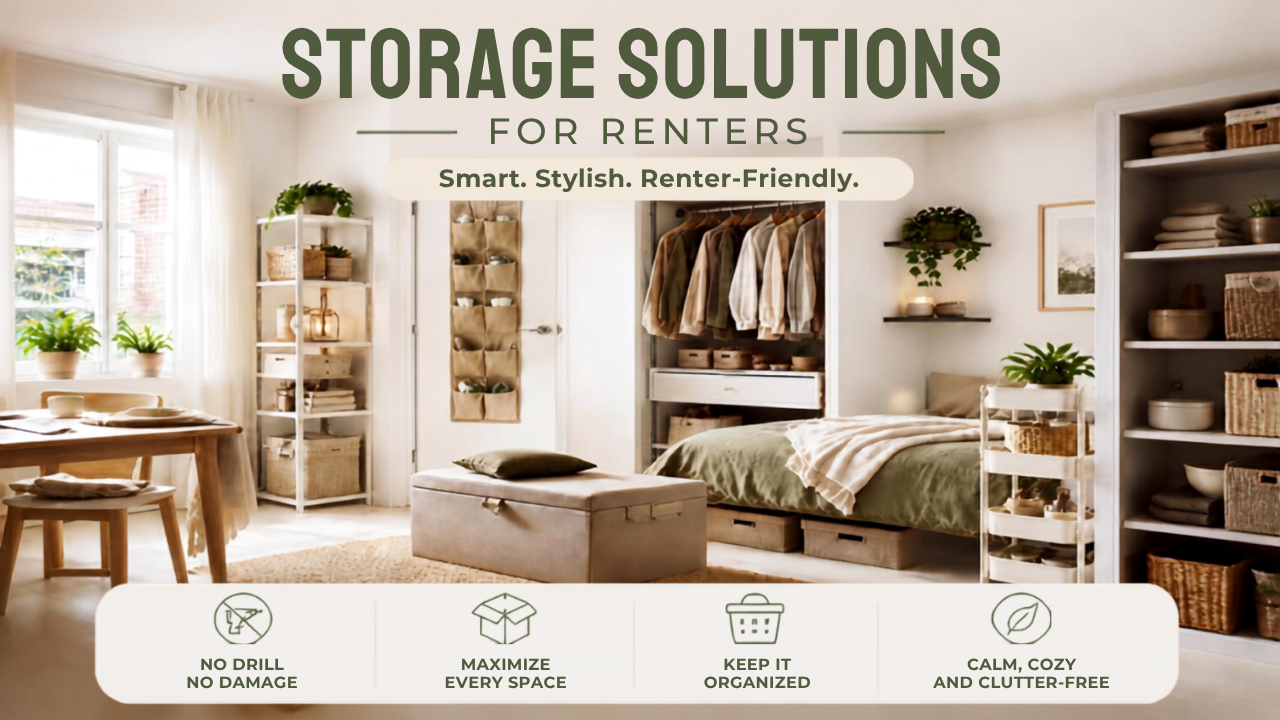
Storage advice online usually assumes you can drill, paint, or build whatever you like. As a renter, that’s rarely the reality — every hack has to survive a tenancy agreement and, ideally, a final inspection. Here are ten storage ideas that actually work within those limits, without putting your deposit at risk.
1. Command strips and hooks, not nails
Damage-free hooks have come a long way from the flimsy versions you might remember. The good ones (look for weight ratings on the packaging) can genuinely hold several kilograms, which is enough for coats, bags, mirrors, or even small floating shelves. The trick to getting a clean removal later is temperature and patience. Warm the strip slightly with a hairdryer before pulling it straight down (not outward) from the wall, and it should come away without taking any paint with it. Test one in an inconspicuous spot first if you’re ever unsure about your specific wall finish.
2. Tension rods instead of fixed rails
A tension rod wedges into place using pressure alone, with a spring mechanism inside that pushes outward against two surfaces — no drilling, no wall damage, and no tools beyond your own hands. They’re brilliant for adding a second hanging rail inside a wardrobe (instantly doubling your hanging space), creating a makeshift shelf under a sink by resting a small tray or divider on top, or sectioning off part of a cupboard to separate items that keep sliding into a jumbled pile. Buy one slightly longer than you think you need; most adjust down easily, but a rod that’s too short simply won’t work at all.
3. Freestanding shelving units
Since you can’t always add shelves directly to a wall, freestanding units do the same job without needing landlord permission at all. Slim, tall units are especially good in small flats. They add real storage capacity while taking up a relatively small footprint, since they build upward rather than outward. Look specifically for narrow-depth units (around 25-30cm deep) designed for small spaces, rather than standard bookcases, which often eat more floor space than they’re worth in a compact room.g much floor space.
4. Over-the-door organisers
Every door in your flat, including internal ones like a wardrobe or bathroom door, is unused vertical storage sitting in plain sight. These organisers hang directly over the top of any standard door using simple hooks, needing no tools and no permanent fixing at all. They work particularly well for shoes (which otherwise tend to pile up on the floor), cleaning supplies you want out of sight but still handy, or bathroom essentials that would otherwise clutter a small sink area. A bonus: because they hang rather than attach, you can move them between rooms whenever your storage needs change.
5. Under-bed storage boxes
The space under your bed is one of the most overlooked storage areas in a small rental, often sitting empty simply because it’s out of sight. Flat, wheeled storage boxes are designed specifically for this gap, making it genuinely easy to store out-of-season clothes, spare bedding, or even shoes without it becoming a dust-collecting mess shoved randomly underneath. Measure the clearance under your bed frame before buying — most standard boxes are designed for around 15- 18 cm of clearance, but bed frames vary more than you’d expect.
6. Stick-on hooks inside cupboards
Adding hooks inside cupboard doors, rather than on visible walls, is one of the easiest ways to add genuinely useful storage that’s completely invisible once the door is closed. Inside a kitchen cupboard, this works well for hanging cleaning cloths, oven mitts, or small utensils you use often but don’t want cluttering a drawer. Inside a bathroom cabinet, it’s ideal for hanging a hairdryer or small toiletry bags. Since these are hidden once closed, you can use slightly stronger adhesive options here than you might risk on a visible wall, since any minor residue simply won’t be seen.
7. Storage ottomans and benches
Furniture that opens up for storage is a genuine small-space essential, since it solves two problems (seating or a surface, plus storage) using only the floor space of one item. An ottoman placed at the end of a bed works well for spare bedding or out-of-season clothing, while a storage bench by the front door is ideal for shoes, umbrellas, or things you grab on the way out. When choosing one, prioritise a lid or top that lifts smoothly and stays open on its own; cheaper models sometimes have hinges that make one-handed access frustrating in daily use.
8. Corner shelving units
Corners are almost always wasted space in a small flat, since most furniture is designed for flat walls rather than awkward angles. A freestanding corner shelf unit adds real, usable storage without shrinking your usable floor area anywhere else in the room, and because it’s freestanding, it’s fully removable when you move out with zero trace left behind. These work especially well in small living rooms or bedrooms where every other wall is already committed to a bed, sofa, or wardrobe.
9. Removable adhesive shelf liners for cupboards
These aren’t just decorative. A good quality liner genuinely protects the cupboard surface underneath from scuffs, stains, and general wear, which matters more than most renters realise when it comes to getting a full deposit back. Look specifically for liners labelled “removable” or “residue-free,” since some cheaper versions leave a sticky film behind after months of use. They’re especially worth using in kitchen cupboards and under the sink, where spills and general wear tend to be worst.
10. Slimline trolleys on wheels
A slim, wheeled trolley — the kind designed to slot into narrow kitchen gaps is one of the most flexible storage pieces a renter can own. It moves wherever you need it, fits into gaps most fixed furniture simply can’t, and requires zero installation of any kind. Use it in the kitchen for extra counter space and storage, roll it into a bathroom for towels and toiletries, or keep it beside a desk for office supplies. Because it’s fully mobile, it’s also one of the easiest pieces of furniture to take with you when you eventually move.
Final thoughts
None of these require permission, tools, or any real risk to your deposit — which is really the whole point. Small, damage-free changes like these add up to a genuinely more organised space, without ever putting your tenancy at risk.