
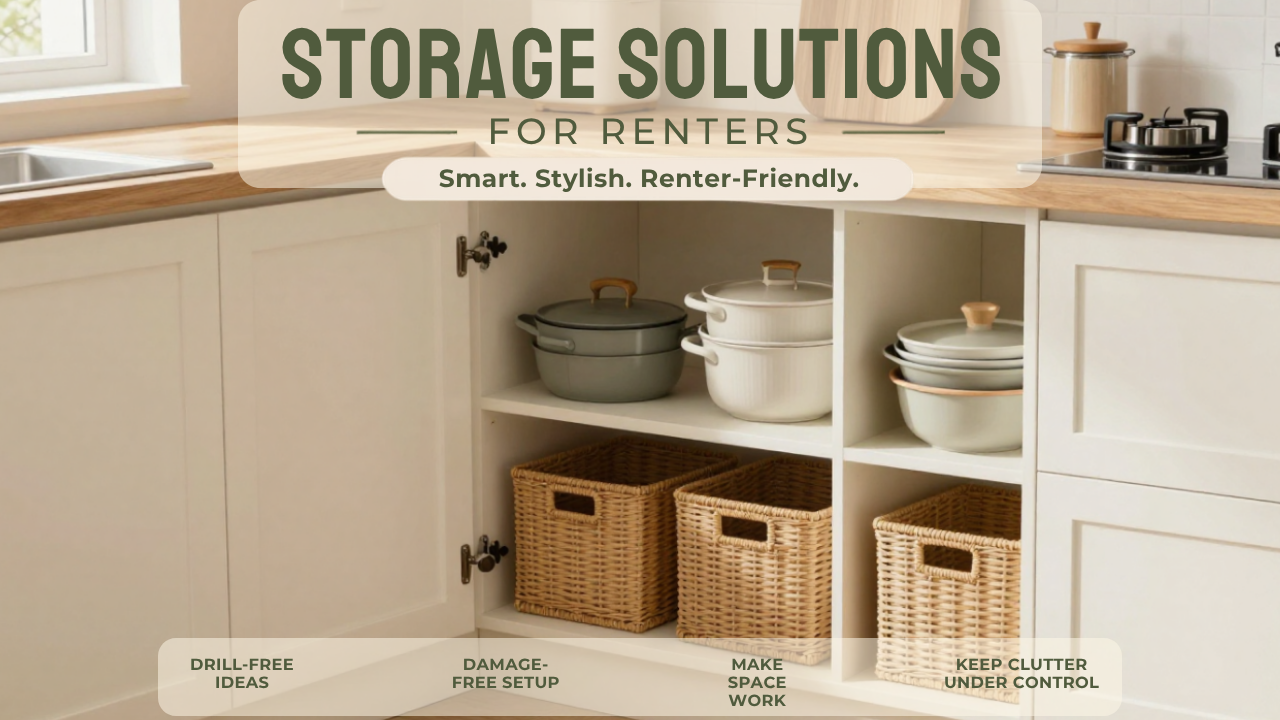
Of every room in a small rental, the kitchen is usually the one that feels most impossible to organise — awkward cupboards, barely any counter space, and no room to expand. After years of renting flats with genuinely tiny kitchens, here’s what’s actually made a real difference for me.
1. Use vertical space above the counter
Wall space above your counters is often empty in a small kitchen, even though it’s some of the most useful storage available. A slim wall-mounted rack or a tension-rod shelf (no drilling needed) can hold spices, oils, or utensils that would otherwise clutter your counter or a crowded drawer.
2. Stack cups and bowls with dividers
Cupboards in small kitchens are often deep but not very wide, which leads to items getting stacked in a way that makes the bottom ones impossible to reach without unstacking everything. A simple set of stacking shelves inside a cupboard turns one deep shelf into two usable levels, so you’re not digging through a precarious tower every time you need a bowl.
3. Use the inside of cupboard doors
The back of every cupboard door is unused storage. Small adhesive hooks or a slim door-mounted rack can hold measuring spoons, oven mitts, or lids that would otherwise take up an entire drawer on their own.
4. Corral lids separately from pans
Pan lids are one of the biggest sources of kitchen cupboard chaos, since they rarely stack neatly with anything else. A simple wire or plastic lid organiser (often under £10) keeps them upright and separated, freeing up the actual pan storage from being wasted on awkward lid shapes.
5. Keep counters almost entirely clear
In a small kitchen, counter space is your most valuable real estate, and it disappears fast if it becomes a dumping ground for appliances you rarely use. Keep only what you genuinely use daily on the counter (kettle, perhaps a toaster) and store everything else away, even if that means slightly less convenient access to something you only use once a week.
6. Use a slim rolling cart for overflow
When cupboard space genuinely runs out, a narrow rolling cart (the kind designed to fit into a gap beside a fridge or cupboard) adds real extra storage without needing any permanent fixture. It’s also fully mobile, so it can move to wherever it’s most useful as your needs change.
7. Repurpose a tension rod under the sink
The area under the sink is often one deep, unstructured space that becomes a jumble of cleaning products. A tension rod fitted horizontally partway up creates an improvised second level, letting you hang spray bottles by their trigger handles instead of them all just sitting in a pile.
8. Store spices somewhere other than a spice rack
If counter space or cupboard depth doesn’t suit a traditional spice rack, consider a drawer-based option instead — a slim drawer divider designed for spice jars, viewed from above, uses space that’s often otherwise wasted on a shallow, awkward drawer.
9. Use clear containers for dry goods
Decanting rice, pasta, and cereal into clear, stackable containers does two things: it uses cupboard space more efficiently than oddly shaped packaging, and it makes it immediately obvious what you’re running low on, which cuts down on both clutter and food waste.
10. Accept that not everything needs a “home” in the kitchen
Some kitchen items — big platters used once a year, a spare teapot, seasonal baking tins — don’t need to live in your already-tight kitchen storage at all. Storing rarely-used items elsewhere in the flat (a wardrobe shelf, under the bed) frees up real everyday space for the things you actually reach for.
Final thoughts
A small rented kitchen will probably never feel spacious, but it can feel a lot less chaotic with a few adjustments like these. None of them require permission, tools, or any risk to your deposit — just a slightly different way of using the space you’ve already got.