
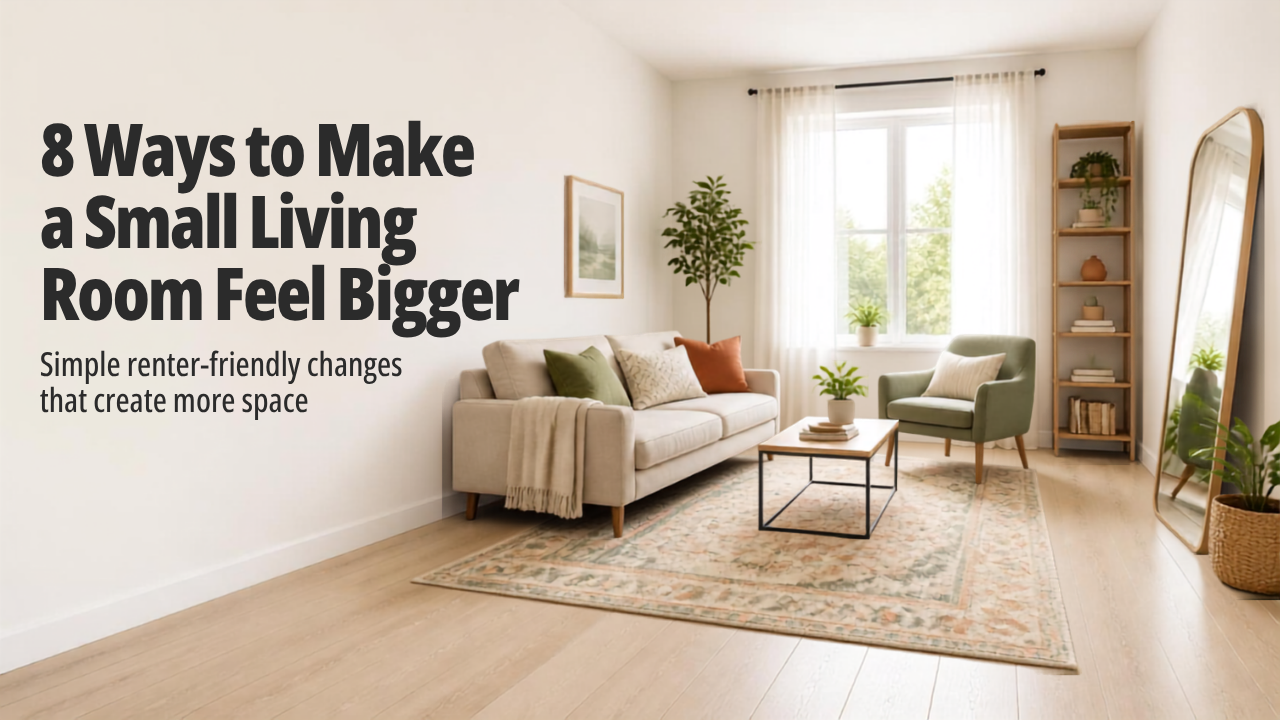
A small living room can feel like it’s shrinking further the more furniture and belongings you try to fit into it. After living in a few genuinely tiny rented living rooms myself, here are eight changes that actually made a real difference to how spacious the room felt.
1. Choose furniture with visible legs
Furniture that sits flush to the floor blocks sightlines and makes a room feel more crowded than it is. Sofas and chairs with visible legs let your eye see floor space underneath, which tricks the brain into reading the room as larger, even though the actual floor area hasn’t changed.
2. Use a large mirror opposite a window
A large mirror placed opposite (or near) a window reflects natural light back into the room, making it feel noticeably brighter and more open. This is one of the cheapest, most effective changes you can make, and it requires no permanent fixing if you use a leaning floor mirror instead of a mounted one.
3. Keep your colour palette light and consistent
Dark, busy colour schemes tend to make small rooms feel like they’re closing in. Sticking to a lighter, more consistent palette across walls, furniture, and textiles creates a sense of continuous space, rather than the eye being pulled between contrasting zones.
4. Choose one statement piece, not several
A room full of competing “feature” items (a bold rug, patterned curtains, a bright accent chair, all at once) creates visual clutter even if the room is objectively tidy. Picking one statement piece and keeping everything else simple gives the eye somewhere to rest.
5. Float furniture away from walls where possible
It feels counterintuitive, but pushing every piece of furniture flush against the walls can actually make a small room feel more boxed-in, not less. Even a small gap between a sofa and the wall behind it can make the room feel like it has proper depth rather than being lined wall-to-wall with furniture.
6. Use vertical storage instead of wide furniture
A tall, narrow bookshelf takes up far less visual and physical width than a low, wide unit holding the same amount of storage. Building upward instead of outward keeps more floor space open, which matters enormously in a small room.
7. Limit rugs to one clear, well-sized piece
A rug that’s too small for the room can make the space feel oddly fragmented, while multiple smaller rugs create visual clutter underfoot. One rug, sized to anchor the main seating area properly, does more for a room’s sense of scale than several mismatched smaller ones.
8. Maximise natural light wherever possible
Heavy curtains or furniture blocking a window cut off one of the most powerful tools for making a small room feel bigger. Light, sheer curtains (or none at all, if privacy allows) let in as much natural light as possible, which does more visual work than almost any single piece of furniture.
Final thoughts
None of these changes require a renovation or a big budget — mostly just a different way of arranging what you already have. A small living room will always be small, but it doesn’t have to feel that way.